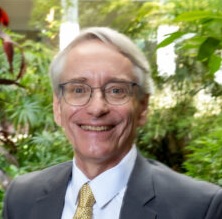
Professor Aluísio Augusto Contrim Segurado graduated from the Faculty of Medicine of USP in 1980, the year in which he worked voluntarily at the Advanced Campus in Marabá (PA), an experience that aroused his interest in infectious diseases and the interface between health, social determinants and the environment. After graduation, he took several courses in the Social Sciences course at the Faculty of Philosophy, Letters and Human Sciences (FFLCH) at USP, while already dedicating himself to residency in Infectious and Parasitic Diseases at the Hospital das Clínicas of FMUSP. This experience provided him with humanistic perspectives that continue to guide his work.
Hired as a professor in the Department of Tropical Medicine at FM in 1983, still as a Teaching Assistant, he later became coordinator of the Advanced Campus project which has had an active participation in facing the epidemic of HIV infection in Brazil, since its inception, reconciling patient care with science and social responsibility. Aluísio completed his master’s, doctorate and international internships, including a period in Japan, consolidating an academic career marked by scientific production and the integration of research and medical practice in the care of people living with HIV and other sexually transmitted infections.
Aluísio has supervised several masters, doctors and post-doctors. He obtained the Habilitation in 2001, completed Postdoctoral internships abroad and won the position of Full Professor at FMUSP in 2012, performing throughout his career prominent functions at FM, HC and the university. He was Head of Department, Coordinator of Medical Residencies, President of the CPG and of the International Relations Commission of FM; Executive Vice-Rector of International Relations, the first Coordinator of the Office of Management of Academic Performance Indicators and Pro-Rector of Undergraduate Studies at USP, functions in which he improved academic processes, expanded national and international partnerships and contributed to the modernization of university management.
Aluísio’s trajectory combines solid technical training with strategic institutional experience, having played a decisive role as director of the Central Institute of Hospital das Clínicas during the covid-19 pandemic, when he coordinated responses to one of the greatest health challenges in recent history. With a performance that integrates academic excellence, management experience and social commitment, it has consolidated itself as a reference in infectious diseases and public health, higher education and institutional governance, symbolizing the convergence between medical training, cutting-edge research, university vision and citizen responsibility.