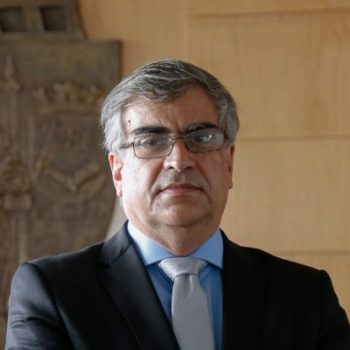
Professor Carlos Gilberto Carlotti Junior graduated in Medicine from the Ribeirão Preto Medical School (FMRP) in 1983, with distinction in clinical training, and completed his specialization in Neurosurgery at the Ribeirão Preto Clinical Hospital (HCRP), becoming a certified specialist by the Brazilian Society of Neurosurgery. He earned his Master’s degree (1993) and Ph.D. (1998) from FMRP. His academic trajectory includes a fellowship at Hospital Foch, in Paris (1992), and a postdoctoral fellowship at the Arthur and Sonia Labatt Brain Tumour Research Centre of The Hospital for Sick Children, in Canada (1999), with which he maintains ongoing scientific collaboration.
He is a member of the São Paulo Sciences Academy (ACIESP), a Level 1C Productivity Research Fellow of the National Council for Scientific and Technological Development (CNPq), and a member of the Higher Council of the São Paulo Research Foundation (FAPESP). He is Full Professor in the Department of Neurology at the Medical School (FMUSP) and Head of the Division of Neurosurgery at the Clinical Hospital (HC), combining clinical excellence with intense academic engagement.
Throughout his career, he has also distinguished himself in university and hospital administration. He served as Clinical Director of HCRP (2006–2009), President of the Specialist Certification Committee of the Brazilian Society of Neurosurgery, Chair of the Graduate Studies Committee at FMRP, Dean of FMRP (2013–2016), and President of the Ribeirão Preto Medical Research Foundation (2016–2019).
At the University of São Paulo (USP), he served as Provost for Graduate Studies (2016–2021) and subsequently as President of the University (2022–2025).